Service
Heated screed in Hamburg
Over underfloor heating the screed has to do more: conduct heat evenly, withstand temperature changes and have joints in the right places.
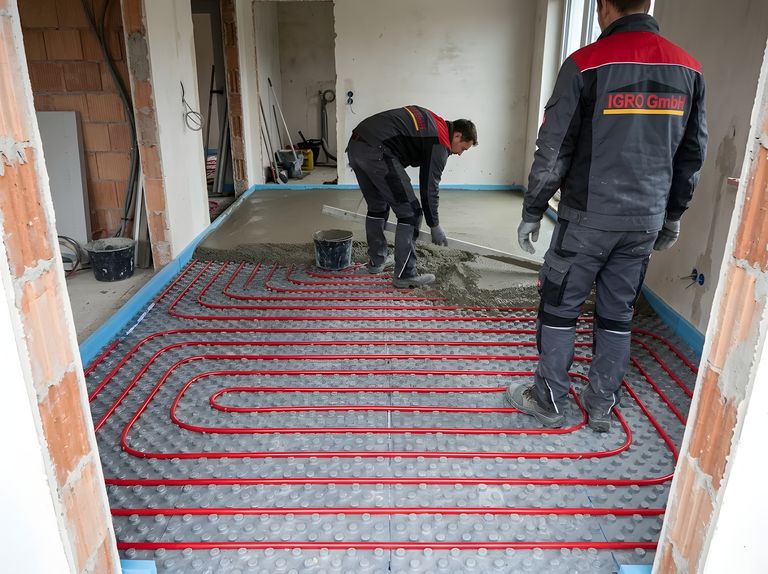
Heated screed is a floating screed in or under which the pipes of the underfloor heating lie. In the usual type A, the pipes lie in the screed. Over the pipe, at least 45 mm is usual for cement screed CT-F4. Before the covering, the screed is heated up following a protocol.
Cement screed over underfloor heating
We lay heated screed as cement screed. It is robust, tolerates moisture and is therefore the safe solution in a bathroom with a level-access shower as well. For even heat output the mortar has to surround the pipes completely, so we compact it carefully. When the schedule is tight, we look at fast-drying screed. We advise you based on room, covering and programme.
Before the screed: this must be finished
- Insulation, edge insulation strip and covering layer are complete and undamaged.
- The heating pipes are laid, fixed and tested for leaks.
- The pipes stay filled and under pressure during laying.
- Joints and heating circuits are coordinated. Pipes cross movement joints only as connecting pipes in a protective sleeve.
Joints in heated screed
Heated screed expands. With cement screed we plan movement joints as a rule for bays over about 40 m², for side lengths over 8 m, in door openings and in awkward layouts. The designer's joint plan is what counts.
Heating up: function heating and drying heating
Function heating under DIN EN 1264-4 tests the heating and relieves stress in the screed. For cement screed it starts no earlier than 21 days after laying: three days at 20 to 25 °C flow temperature, then four days at the maximum design temperature. Function heating does not replace the check of readiness for covering. For that, drying heating follows if needed, and always the CM test.
With the timeline planner you create a heating protocol with the data of your project, ready to print. The background is explained in the guide Heating screed up.
FAQ
Questions about Heated screed
How thick must screed be over underfloor heating?
Over the heating pipe, at least 45 mm is usual for cement screed CT-F4. Together with the pipe, that usually gives cement screed a thickness of roughly 60 to 65 mm. The design sets the value.
When may the underfloor heating be switched on after the screed?
For function heating, no earlier than 21 days for cement screed, unless the manufacturer states otherwise. Before that, the screed must not be heated.
Does screed with underfloor heating have to be heated up?
Yes. Under DIN EN 1264-4, function heating is part of the construction sequence and is recorded. Floor layers usually ask for the heating protocol before laying.
Does screed dry faster when heated?
Yes, that is the purpose of drying heating. The flow temperature is raised step by step following the manufacturer's protocol and held, with ventilation meanwhile. Heating too early or too fast can cause cracks.
Services
More services
-
 01
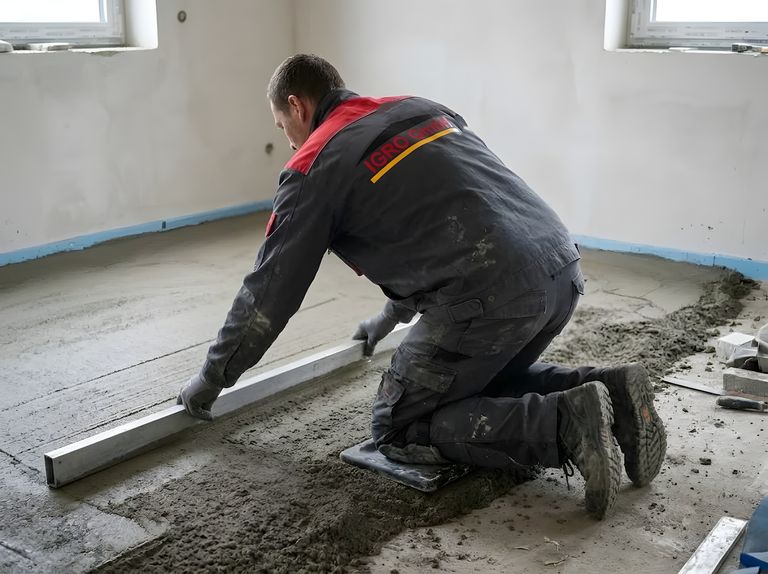
Cement screed
The robust standard for housing, basements, garages and wet rooms.
Learn more -
 02
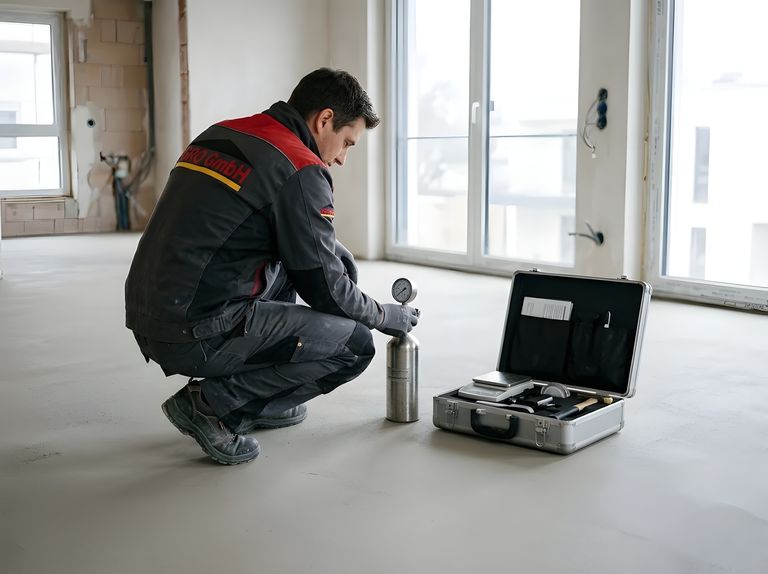
Fast-drying screed
When the programme is pressing: walkable sooner, ready for covering sooner.
Learn more -
 03
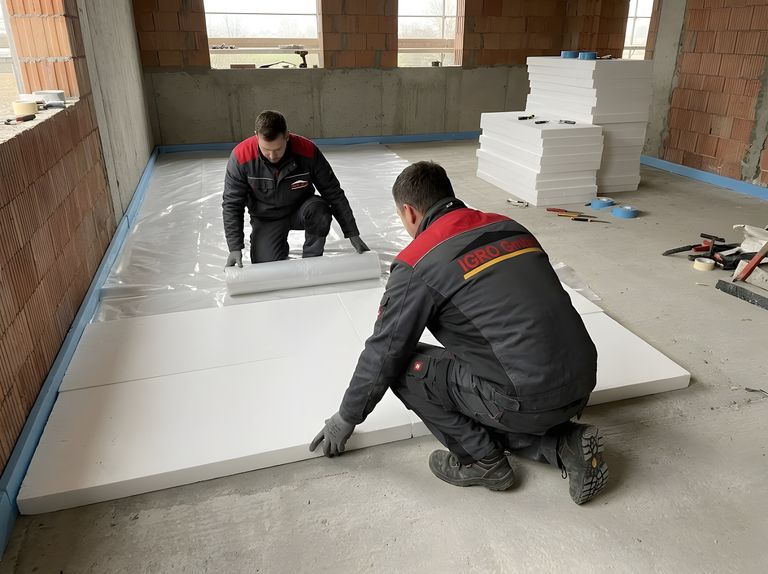
Screed on insulation
Thermal and impact sound insulation, edge strip and film as the substructure for floating screed.
Learn more -
 04
Industrial and commercial screed
Large areas for commercial use, halls and underground car parks: bonded screed and screed on a separating layer.
Learn more