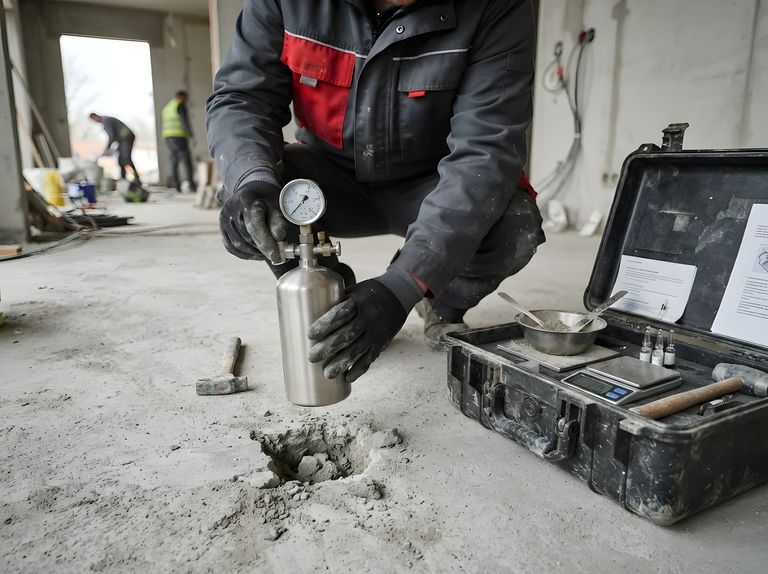
Cement screed is walkable after about 3 days, lightly loadable after about a week and fully loadable after about 28 days. Up to readiness for covering, the rule of thumb is one week per centimetre of thickness up to 4 cm and two weeks for every further centimetre. The CM test is what decides: cement screed at most 2.0 CM-%, heated 1.8 CM-%.
Three points in time to tell apart
| Point in time | Cement screed | Fast-drying screed |
|---|---|---|
| Walkable | after approx. 3 days | after hours to 1 day, depending on product |
| Lightly loadable | after approx. 7 days | after approx. 2 days |
| Fully loadable | after approx. 28 days | after approx. 7 days, depending on product |
| Ready for covering | at ≤ 2.0 CM-% (heated 1.8) | limit per data sheet |
The times are guide values. The manufacturer's data for the product in question is what counts.
The rule of thumb and its limits
One week per centimetre up to 4 cm, above that two weeks per centimetre: for 6 cm of cement screed that makes about 8 weeks. The rule assumes about 20 °C, normal humidity and regular ventilation. In a cold, damp shell it takes much longer. Thick screeds dry disproportionately slowly, because the water has to travel from deep down through the whole layer.
How the CM test works
For the CM test, a sample is taken at the dampest spot over the full cross-section of the screed, crushed and weighed. The sample goes into a pressure bottle with steel balls and an ampoule of calcium carbide. When shaken, the ampoule breaks and the carbide reacts with the water in the sample to form gas. The pressure on the gauge shows the water content in CM-%. The CM test is the method recognised on site. Electronic meters serve only for a preliminary check.
Ventilating correctly
- Cement screed: in the first days protect it from draughts and from drying out too fast.
- Heated screed: the heating stays off until function heating.
- Airing in short bursts several times a day works better than windows left tilted all the time.
- Do not store films, boards or stacks of material on the area: nothing dries underneath.
- Use dehumidifiers only after the initial phase, and keep the rooms closed while doing so.
Speeding up drying
With heated screed, drying heating shortens the wait, see Heating screed up. If the deadline is tight from the start, fast-drying screed is the plannable solution. The timeline planner calculates dates for your laying date.
As of 25 November 2026. The information is general technical guidance. It replaces neither the design nor the manufacturers' data for your project.