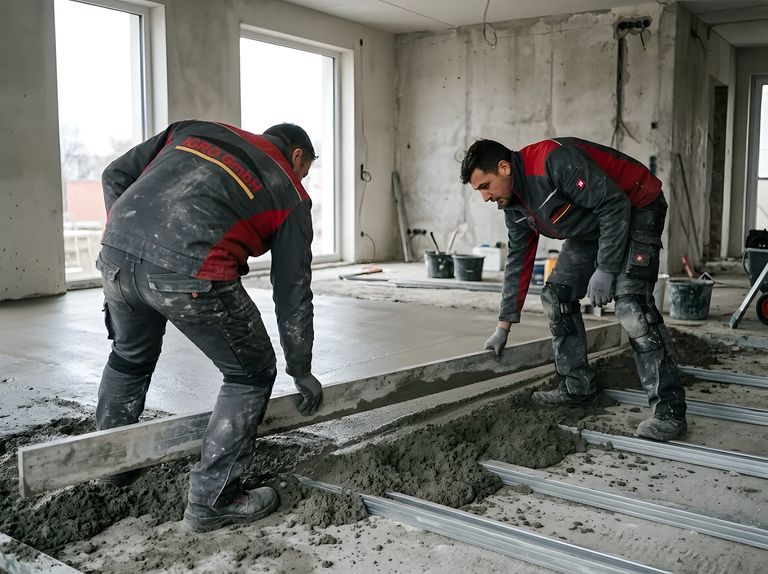
Screeds are distinguished by binder and by construction method. In housing and commercial building, cement screed (CT) is the standard: moisture-resistant, load-bearing and suitable indoors and outdoors. Fast-drying screed is the variant for tight schedules. By construction method there are bonded screed, unbonded screed on a separating layer, floating screed on insulation and heated screed.
Screed types by binder
| Screed type | Code | Strengths | Limits |
|---|---|---|---|
| Cement screed | CT | moisture-resistant, strong, indoors and outdoors | shrinks, needs joints, dries more slowly |
| Fast-drying screed | mostly CT | ready for covering after days | dearer, short working time |
| Mastic asphalt screed | AS | usable at once, water-free, thin | laid hot, specialist trade |
| Synthetic resin screed | SR | thin, chemically resistant, fast | expensive, for special cases |
| Magnesite screed | MA | high strength | moisture-sensitive, rare today |
| Dry screed | boards | no drying time, light | lower load capacity, different build-up |
Screed types by construction method
| Construction method | Principle | Typical use |
|---|---|---|
| Bonded screed | firmly bonded to the substrate | heavily loaded areas, basements, commercial |
| Unbonded screed (on a separating layer) | separated from the substrate by a film | ancillary rooms, over waterproofing |
| Floating screed | on insulation, with no contact to wall and slab | housing, sound and thermal insulation |
| Heated screed | floating screed with heating pipes | underfloor heating |
Which construction method for which room?
- Wet rooms, basements, garages, balconies: cement screed, usually bonded or on a separating layer.
- Flats above occupied rooms: floating screed on impact sound insulation.
- Rooms with underfloor heating: heated screed with at least 45 mm over the pipe.
- Halls, warehouses, underground car parks: bonded screed of high strength.
- Tight schedule: consider fast-drying screed.
How to read the designation CT-C25-F4
The designation under DIN EN 13813 first names the binder: CT stands for cement screed. C25 is the compressive strength class with 25 N/mm², F4 the flexural strength class with 4 N/mm². For floating screeds, flexural strength is the decisive figure, because together with thickness it determines what load the screed slab carries.
As of 25 November 2026. The information is general technical guidance. It replaces neither the design nor the manufacturers' data for your project.